 In restaurants, I frequently see a woman, dining alone, leave her purse unattended on her chair while using the restroom. People sleep on the trains while leaving laptops on the shelf above the seats. Remember that I am in Tokyo, the capital city, not a rural community!
The shop pictured below sells antique coins, and displays them unattended in bins outside the store. Some of these coins sell for US$70 or more.
 Bicycle locks here are a flimsy affair. There are several styles of lock. Generally they hold the rear wheel in place so the bike can't be ridden, but there is nothing to stop a thief from picking up the bicycle and carrying it away. Nonetheless, the bikes don't seem to get stolen. A bicycle with this type of lock in Fort Collins, my former town, would surely be stolen, (people will steal just a wheel or a seat if they can get nothing else) but not in Japan!
  In the farm communities outside of Tokyo, and even in an agricultural area within Tokyo, farmers sell their produce at self-serve stands. Customers take what they want and leave payment in a tin can. Neither the produce nor the money in the can is protected from theft, but the system seems to work here. Below you can see yuzu, a special kind of oranges used for the flavorful peel, and a money can on the left.
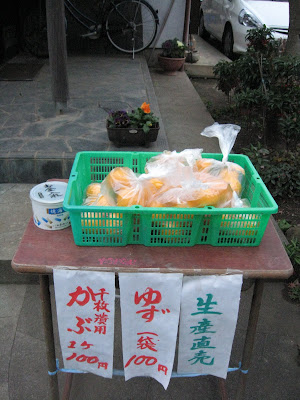 Of course, I am always careful about the way I carry money and belongings while traveling, but it's really pleasant to live in a place where I don't have to worry much about crime.


 (I borrowed this photo from another Flickr user)


 People wait in long lines in order to make a wish at a shrine. When asking the gods to fulfill the wish, the people offer a coin, ring the bell to get the gods' attention, and make the wish. Afterwards, they clap their hands twice if they are at a shrine. If they are at a temple, they simply bow.
 This little girl wore a kimono that her grandmother had worn years ago. Here, she uses cloth napkins to protect the kimono while eating her lunch.
 New Year's decoration
 Daruma for sale. Per Wikipedia, Daruma dolls are hollow and round Japanese wish dolls with no arms or legs, modeled after Bodhidharma, the founder and first patriarch of Zen. The doll has a face with a mustache and beard, but its eyes only contain the color white. Using black ink, one fills in a single circular eye while thinking of a wish. Should the wish later come true, the second eye is filled in. It is traditional to fill in the right eye first; the left eye is left blank until the wish is fulfilled. Because of their low centers of gravity, some types of daruma doll are roly-poly toys: they return to the upright position after being tilted to one side. As such, the daruma has become symbolic for optimism, persistence, and strong determination.
 These women are selling cards that tell your fortune, amulets, and holy Japanese sake at the edge of the shrine. Their white and red clothing indicates that they work for the shrine.


 Posts
Posts


