Saturday, October 3, 2009

Hokkaido Part I, Ice Museum and Higuma Bears

(Republished with photos added)

Itsumi and I are on vacation in Hokkaido, Japan’s north island. We flew here from Tokyo’s domestic airport and I learned that, if you need to remove your shoes during screening, the security people give you a pair of slippers to wear in accordance with Japan’s rules about shoes. In addition, you don’t have to show photo ID in order to enter the secured area. A ticket is enough. And best of all, you can bring plastic beverage bottles through security! They are scanned by a security machine, and this eliminates the massive throwing away and repurchasing of water bottles that occur at U.S. airports every day.

We arrived in Asahikawa, Hokkaido, where we bought lunch boxes and ate them on a bench in front of the train station, under the beautiful sun. We bought one box of fish including sushi and fresh crab, and another box of Genghis Khan. Genghis Khan is popular in Hokkaido and means Mongolian barbecue. Our Genghis Khan contained lamb and sautéed vegetables and rice, and we heated it by pulling a
string in the packaging that ignited some kind of heating material underneath the food.

In 3 minutes, it was piping hot! (But the packaging is probably not very good for the environment). We took a train to Kamikawa where we went to the Ice Museum which advertises temperatures of -41 degrees Celsius (-42 degrees Fahrenheit).

Paying to visit extremely cold temperatures seems like a silly thing for a Minnesotan to do, and this place was quite the tourist trap, but I couldn’t resist the temptation to see what a museum says about temperatures that low. It turned out Kamikawa has the Ice Museum because the town once registered real temperatures of -42 degrees Celsius, the coldest registered temperature in Japan. Before entering the museum the docent had us blow soap water bubbles through a wand to see how the bubbles behaved at a normal temperature. Then we put on parkas and entered the Ice Museum, which consisted of a long and windy tunnel through ice formations and was indeed very cold, especially since we weren’t dressed like Minnesotans!

The temperature in the ice tunnel was actually -20 degrees C (just -4 degrees F) but that felt plenty cold especially with bare hands and trying to blow bubbles and take pictures. Some of the bubbles did indeed freeze when they hit the ground, and I must say that I never thought to blow bubbles in the winter in Minnesota!

Then we got to the main draw of the ice museum, the -41 degree part. It turns out that the real temperature was still just -4 F, but we pushed a button that caused a ten second wind storm creating a wind chill of -41 C (-42 F). Although I've experienced real temperatures of colder than -40 F and a windchill of -75 F in Minnesota, I must say it was very hard to endure ten seconds of the wind chill effect! We literally ran to the exit of the museum where I took this photo of Itsumi with a frozen wet towel.

Outside, in the beautiful sunny fall weather beneath birch trees like the ones in Minnesota we saw higuma bears, Hokkaido's brown bears. They are VERY big, bigger than any other bears I've ever seen! But these bears, a side attraction at the ice museum, were in a rather sad condition, confined in a cement enclosure and waiting for tourists to throw food pellets provided by the museum. As we entered carrying our bags of pellets, the bears struck many cute poses, some even like yoga poses, hoping to be rewarded with treats. Unfortunately, by visiting this attraction we encouraged it to continue.

This bear tries to catch a treat thrown by a tourist.
There were also a few Kodiak bears from Alaska, which have very long claws but are smaller than the higuma bears.

The town of Kamikawa reminds me of North Dakota with its wide empty streets, tiny business district and small grocery store where the locals gossip about each other. This is a part of Japan much different from the Tokyo area which I have become accustomed to!

Monday, September 28, 2009

Barcode Hair

My favorite new Japanese expression is "barcode hair," pictured above. Second favorite: "pudding hair." Pudding means flan in Japan, and pudding hair is dark hair dyed blonde, with dark roots growing out on top.


Saturday, September 19, 2009

Summer yukata

Hello everyone,

I haven't written much lately because I've been working many consecutive shifts this summer. Japanese people want to go up into the mountains to escape the heat of Tokyo during the summer, and consequently my English classes up in the mountains are really busy!

But I have had a day off in Tokyo here and there to relax, and on one of those days recently I wore the yukata that I received as a birthday gift and walked to a nearby shrine to take a few pictures.

In the photo I'm carrying a furoshiki, or wrapping cloth. The furoshiki is a square piece of beautiful fabric, and Japanese people can tie it into many beautifuly styles of handbags. Here, I tied a simple one using two wooden rings. The furoshiki was a birthday gift from my friend Mika.

I hope you're all doing well and I will catch up a bit on my blogging when my work schedule settles down. I enjoy receiving your emails even though I haven't been so good at answering lately!

Sunday, September 13, 2009

Dance Festivals!

During summer, there is a festival almost every day in Tokyo! Itsumi and I attended two dance festivals recently. The first was a samba festival, in the style of Brazilian carnival.

This festival may have originated because of the many Brazilians living in Japan. Many of the Brazilians in Japan are actually Japanese who immigrated to Brazil in the early 1900s when opportunities for farmers were better in Brazil than in Japan. Later, some of these Japanese-Brazilians immigrated back to Japan in order to work in the booming industries here. Now that there is a recession, Japan is encouraging this labor force to move back to Brazil. Just as in the U.S., immigrants are sometimes welcomed here and other times encouraged to leave, depending on the economy.
In any case, the samba festival consisted of a parade of dancers dressed (or barely dressed) in beautiful costumes. A few dance troupes were comprised of Brazilians, but most of the dancers were Japanese.

The skirts on the compasses pictured below twirled around and around.
The costumes were beautiful and I was so happy to see samba, but I felt like the dancers didn't dance with the same energy and dedication as the carnival dancers I saw in South America.

I also noticed that the audience consisted mainly of older men with big cameras!
The next weekend, Itsumi and I went to an awa-odori festival, which is a type of Japanese dance performed to Japanese instruments.
Although a typhoon blew in part way through the parade, the dancers danced with as much energy as I've ever seen anywhere.


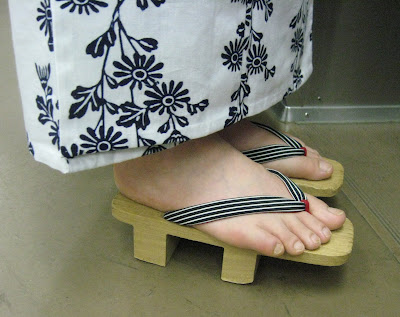
The women in the awa odori parade dance on their toes while wearing geta, or traditional Japanese shoes. They danced on their toes through the entire parade route, and I never saw so much energy!

The samba festival was beautiful, but the Japanese dancers were simply wearing another culture's costumes and dancing to another culture's music. The awa odori festival, in contrast, is a Japanese tradition and despite the typhoon the dancers danced and the musicians played with all of their energy, and it was truly beautiful.

Wednesday, August 5, 2009

Maid Cafe

I visited a maid cafe yesterday. Maid cafes are popular in Akihabara, a section of Tokyo where the otaku hang out. Otaku are hard-core fans of anime and manga, and they enjoy the fantasized French-style maids who serve the customers as a maid would serve her "master" and "mistress" in their home. I heard that the maids greet customers by saying "welcome home master" but if they said this I wasn't able to understand it.
Customers are not allowed to take pictures inside the cafe, but I managed to take a couple of shots of maids on the street, inviting potential customers to visit the cafes. There are more than 30 maid cafes in Akihabara.

Really, I thought the "maid" service was not much different from service in a typical Japanese restaurant (which is much better than service in American restaurants, and you are not expected to tip). But the maid server did lots of cutsy things like making a cute drawing using ketchup over a plate of food. She drew a ketchup bunny, and as she drew she said, in a little girl voice that I can't even begin to imitate, "these are the ears, and the nose ..." For my benefit she said this in English. One visit to a maid cafe was enough for me. The food wasn't so great, and I don't really care for the idea of being "served" by a maid, but it was something to see once.
Also, it helped me see the importance of fantasy in Japanese culture. Japan is a huge exporter of its fantasy culture such as anime and manga.
People can go to a maid cafe and enjoy the fantasy of being served by a maid for an hour or two over coffee and dessert. But like all fantasies, some people take it too far. Maid cafes often have printed rules warning customers not to touch the maids, not to ask for their phone numbers, and not to wait outside the cafe for a maid to finish her shift.
There are also butler cafes, which cater to women customers, and cross-dressing cafes where men dress as maids or women dress as butlers.
More information about maid cafes is available at http://en.wikipedia.org/wiki/Maid_cafe.


Soba

Soba are buckwheat noodles, a common food in Japan. You can eat soba noodle soup at cheap restaurants where the customers eat standing at a counter, or at expensive specialty restaurants where the soba is made by hand in the front window of the restaurant, as pictured here.

Soba noodle soup is eaten with chopsticks, and should be slurped. I find it funny to stand in a restaurant eating soba with twenty standing slurping strangers. I like eating soba with chopsticks, but I'm not very good at slurping. At first it took me longer than average to eat a bowl of soba, but now I can eat it as quickly as the other customers.
Below is a plastic model of a plate of soba. Japanese restaurants usually have realistic-looking plastic models of their food in the front window. This is great for illiterate folks like me. The factory that makes most of this plastic "food" is in the mountains not far from Tokyo, and I've heard that tourists can try their hand at making plastic food there for a small fee.
I also like soba in the form of tea, made by pouring hot water over buckwheat kernels in a mug. More information about soba is available at http://en.wikipedia.org/wiki/Soba.

Saturday, July 25, 2009

Sumidagawa Hanabi, or flower-fire festival

Each summer Japan has many fireworks, or "flower-fire" festivals, and the biggest is the Sumidagawa Fireworks Festival on the Sumida River in Tokyo. The festival, dating from 1732, is a competition between rival pyrotechnic artists resulting in fireworks in beautiful complex shapes such as a willow tree and a sunflower. A million people attended the festival, which contained 21,500 fireworks this year.

Itsumi and I went to the festival with four friends who all wore beautiful traditional yukatas, complete with fancy obi, or belts, and geta, or traditional shoes.

Because the festival is so popular, we arrived several hours early to claim a square of pavement for our picnic cloth, and waited with thousands of other people at Senso-ji temple, from where the papers said we would have a good view of the fireworks.
When the fireworks finally started, it was clear that the papers were wrong and our view was blocked by two tall buildings.
Luckily, we were able to find another spot from where we had a good view down a street, and we even got a glimpse of two geisha as they slipped through the crowd! We just got a quick glimpse and no photos, but we saw that their faces were painted white and they were adorned with many dangling accessories.

As a Minnesotan used to watching fireworks over a lake, I found it fun to watch them in such an urban environment between miles and miles of skyscrapers.
And the fireworks were like one continuous grand finale, shooting off right in a row or at the same time, with no pauses, for an hour and a half. Beautiful! Afterwards we went to a Bangladeshi restaurant. Mmmm.
There are several free festivals every week in Tokyo during the summer. Sometimes it's hard to keep up!