 One of the courses I was scheduled to teach got cancelled, and I suddenly had a two-week vacation, so I decided to take a trip to Bali with my friend Maki.
Bali is famous for its beaches, but the place I really loved in Bali was Ubud. An hour into the island’s mountainous interior, Ubud is a vibrant tropical paradise full of culture and warm people. We checked into a guesthouse called Sania’s House.

Entering the grounds felt like entering a temple, and I can hardly describe how beautiful Sania’s House is! 
Apparently the place is a rich person’s estate turned into bungalows. A series of beautiful stone buildings are nestled among a tropical garden and swimming pool, stone sculptures and flowers. All for $30 a night for two people. 
In the morning I took a bicycle tour which started with breakfast overlooking a volcano and crater lake. 
From there we bicycled 35 km downhill through terraced rice fields and small villages, giving high fives to local school children who came out to meet us with shouts of “hello.” 


 We stopped at a coffee plantation where we learned that coffee beans come in female and male, and we watched two bean sorters meticulously sorting the beans by their sex, which will result in different tastes of coffee. I may be completely undecided about my future career path, but I’m sure I don’t want to be a coffee bean sex sorter!

 Then we sampled several coffees and teas, including a very special and expensive one called luwak coffee. This coffee is made with the help of an animal called a civet.

The civet, who eats the coffee bean when it is enclosed in a fruit, is quite a coffee bean connoisseur, choosing only the best beans. The fruit passes through the civet’s digestive system and the bean comes out whole.
The coffee farmers were angry with the civets, who ate the best coffee beans! Trying to recoup their losses the farmers gathered the beans from the civet poop and washed them, roasted them, and made coffee from them. They discovered that the civet’s digestive process actually removed the coffee’s bitterness, resulting in a spectacular cup of coffee! The below beans on the right are luwak coffee, while those on the left are regular coffee.

So now, luwak coffee, made from civet poop, sells for up to $100 a cup in gourmet restaurants in the U.S., Japan and Australia. In Bali, it’s only $3 a cup, and I tasted a sip of it although I gave up coffee a couple of years ago.


On the bicycle tour I also visited a rice field and saw how the women threshed the rice by hand. 
First they loosened the hulls by flailing the rice stalks against a board. Then they separated the grain from the chaff by repeatedly tossing the rice in the air. The chaff slowly floated away. 
When finished, the women poured the rice into 50 kg bags, which they carried on their heads, seemingly without effort.

A Swiss tourist did it less gracefully! 

 We visited a Balinese farm where we saw a typical kitchen.


In Bali, the women cook only once a day, at 5 a.m. They leave the food in the kitchen and the family members can come in and get something to eat any time they like, as there is no set meal time and the families, who work together all day on the farm, don’t eat together.
In Ubud Maki and I watched several beautiful dance and music performances and met many kind people.


 In addition to Balinese and Indonesian, most of the people I met in Bali spoke English very well, and many also spoke some Japanese.

Here, a woman paints a beautiful batik. 
I feel that in all my travels no locals have been as warm and friendly and helpful as the people of Bali. Although this island is heavily touristed, the locals remain friendly and genuine toward the tourists. Maki was especially good at making friends with the locals. 
Every morning the locals make small offerings and place them everywhere, in shrines, on the sidewalk, on the beach, and they look beautiful.


It turned out that Julia Roberts was in Bali at the same time as I was, filming part of “Eat, Pray, Love” which is based on a travel novel which I read last year. (Thanks, Sue, for giving me that book!) The locals were all excited about it, but I didn’t see her.
Of course we also spent a couple of days on the beach, where Maki tried surfing and I played in the water. I hope that I can return to Indonesia soon, to visit its other beautiful islands.


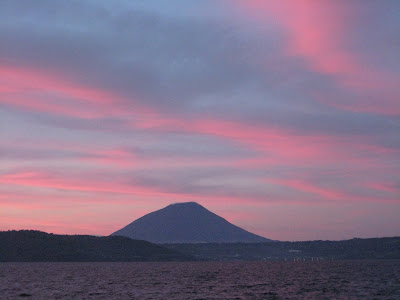 In the evening, after watching a beautiful sunset, I met three Taiwanese tourists who had checked into the youth hostel, and they invited me to ride with them in their rental car to watch the evening fireworks on the lake shore. Afterwards we enjoyed another foot bath.
 The Taiwanese tourists were an interesting group of two men and a woman who met on an internet site that helps people find travel partners. They emailed, decided to travel together, and met in person for the first time at the airport in Taipei! The woman, Sylvia, told me that she has traveled that way several times in the past.


 With lots of stops for photos, exploration of parks, a picnic lunch and a detour to a fruit stand selling local plums, the trip took six hours, all along a quiet road on the rim of the caldera lake.

 As I rounded the lake I enjoyed views of several different volcanos behind the reflective waters, and I saw birds and forests and a snake, several parks, sculptures, and some cute little camping cabins.


 I checked into a youth hostel and rented a bicycle and rode up to Showa Shinzan, which means New Showa Mountain.

 In the early 1940s this place was just a wheat field but from 1943 through 1945 a series of earthquakes raised it to a plateau. Then the volcano surged up out of the ground eventually creating a 1,200 foot volcanic mountain, which is still smoking today.
 Since Showa Shinzan came into being in the midst of World War II, Japanese authorities tried to hush it up and even urged the locals to douse the volcanic flames (they didn't) so that Allied aircraft couldn't use them for orientation.
 Today, Showa Shinzan has become a tourist destination and visitors can take a cable car up the neighboring and much larger Mount Usu for panoramic views of Showa Shinzan, Lake Toya and the Pacific Ocean. Mount Usu is also an active volcano, with its most recent eruptions in 1977 and in 2000.
 Above is an apartment building damaged during a mudflow caused by the 2000 eruption. We are looking at the second floor, as the first was buried in mud. The damage caused to the corner of the building was caused by a huge steel highway bridge that was carried into the building by the mudflow.
 Showa Shinzan seen from the higher Mt. Usu
 A smoking crater on the side of Mt. Usu, above the Pacific Ocean
 Also at Showa Shinzan I visited an Ainu museum, which consisted of a replica of a traditional Ainu house complete with Ainu tools, clothing, and arts and crafts.

 The docent, a woman who is half Ainu and half Japanese, dressed me in Ainu clothing and took my picture, and gave me a gift of a beautifully embroidered tissue case.

 The Ainu are the original inhabitants of Hokkaido, northern Honshu and Sakhalin, an island which now belongs to Russia. Compared with other Japanese, the Ainu have rounder eyes, lighter skin and more facial hair, and some people believe they come from Caucasian origins.


 Posts

