A friend in Tokyo asked me to share the following with you. It contains an update on the current nuclear radiation situation in Japan as well as a request for you to send emails to Japanese government officials urging them to comply with international radiation standards. Please take a moment to read this and send an email.
Itsumi's message:
Since radioactive particles have started spreading around the world, your message will help to save the world and people (especially children). Here are a few examples of what is happening now in Japan:
1. The Japanese government allows fresh food to be on the market although it contains radiation 20-30 times higher than the global safety standard.
2. The Japanese government does not do anything even with food which contains radiation higher than Japanese safety standards.
3. The Japanese government does not inform its citizens of the results of the seafood radiation investigation, and does not allow Green Peace to conduct a thorough investigation of the sea environment around Japan.
4. According to UK researchers, more than 400,000 additional cancers will occur within the next 50 years on account of the radiation if no preventive efforts take place.
5. Air dose levels of radiation do not reflect the actual doses. Official air doses are half or quarter of the actual doses.
6. The Japanese government insists that 20mSv/year is safe for children at a school yard. The amount is 20 times higher than previous safety standards.
7. Data and information about Fukushima has been hidden, although radioactive particles keep spilling into the water and air every day.
8. Several millions of residents who evacuated from the area surrounding Fukushima still live in public buildings, gymnasiums, and such. There is no plan for them yet.
9. Several millions of Geiger counters donated by foreign counties are sitting, unused, in a warehouse.
Please send an email about these issues to the following Japanese officials:
Mr. Naoto Kan, prime minister (for all of the above): kan-naoto@nifty.com
Mr. Hosokawa, Ministry of Health, Labour and Welfare (Points 1.2.3.4): h04091@shugiin.go.jp
Mr. Takagi, Ministry of Education, Culture, Sports, Science and Technology (Points 5, 6): g02653@shugiin.go.jp
Mr. Kaieda, Ministry of Economy, Trade and Industry (Points 7, 8) office@kaiedabanri.jp
Mr. Matsumoto, Foreign Ministry (Point 9): info-matsumoto@memenet.or.jp
Please urge them to:
1) Conform to global standards on radiation safety in terms of food, water, and the environment
2) Check radiation levels in the air and water, and on the ground, which are more suitable to protect human life
3) Make all updated radiation information easily available to everyone
4) Disclose information and data regarding the Fukushima plant to Japanese and also the world
5) Take appropriate care of residents who have evacuated and who want to evacuate from Fukushima prefecture
6) Utilize the Geiger counters and other resources donated from foreign countries
*****
Thank you so much for taking the time to read this message. Itsumi regularly tweets about the radiation and earthquake situation. You can follow her tweets at http://twitter.com/#!/ikrockhopper
Friday, May 27, 2011


Thursday, May 12, 2011
Update on the ongoing nuclear disaster in Japan
TEPCO (the Japanese power company) finally was able to enter Reacter No. 1, and they found that a complete meltdown had happened there. For weeks they had been dumping sea water into the container that holds the rods, but they now know that it was to no avail, and none of the water stayed in the container. When they entered the area they found that the water gague was not working, so all of their readings had been false. They also found that there was no water in the pressure vessel (critical container) or in the container vessel (shell of the pressure vessel), although they had already poured 10,000 tons of water in to keep the rods cool. TEPCO finally admits that the rods are exposed, and probably melted down to the bottom of the pressure vessel.
One surprise was that the temperature of the pressure vessel is very low, which implies that the hot rods are not at the bottom of the pressure vessel. The rods may have melted the bottom of the pressure vessel and piled up at the bottom of the container vessel. Or, even worse, they may have reached the concrete ground of the building, or even lower. Nobody knows.
TEPCO planned to fill the vessels with water and cool down the rods, but, since they now know that the pressure vessel is broken, they must change their plan. However, the only thing they are able to do is keep pouring on the water, even though they don't know where it is going. Nobody knows where the 10,000 tons of radioactive water have gone.
Many experts including those in the U.S. say that a meltdown has happened in three reactors to a certain degree, but they can't say to what extent. Now, a 100% meltdown has been confirmed at Reactor No. 1.
Presumably the situation at Reactor 3 continues to be dire, and is especially dangerous because Reactor 3 contains the more dangerous MOX plutonium fuel. The situation at No. 4 is also obviously not good, because recently the No. 4 building has been visibly leaning. A video about the leaning No. 4 building and the fact that information is being controlled in order to avoid panic is here: http://www.youtube.com/watch?v=aPWLwTiSv_Y&feature=youtu.be
The nuclear disaster hasn't gotten any better, but life continues on in Japan. I summarized this update from news that Itsumi, who is in Tokyo, has sent me. She is tweeting regular updates about the disaster situation in Japan. You can read them yourself at http://twitter.com/#!/search/ikrockhopper, or go to http://twitter.com/ and search for ikrockhopper.
One surprise was that the temperature of the pressure vessel is very low, which implies that the hot rods are not at the bottom of the pressure vessel. The rods may have melted the bottom of the pressure vessel and piled up at the bottom of the container vessel. Or, even worse, they may have reached the concrete ground of the building, or even lower. Nobody knows.
TEPCO planned to fill the vessels with water and cool down the rods, but, since they now know that the pressure vessel is broken, they must change their plan. However, the only thing they are able to do is keep pouring on the water, even though they don't know where it is going. Nobody knows where the 10,000 tons of radioactive water have gone.
Many experts including those in the U.S. say that a meltdown has happened in three reactors to a certain degree, but they can't say to what extent. Now, a 100% meltdown has been confirmed at Reactor No. 1.
Presumably the situation at Reactor 3 continues to be dire, and is especially dangerous because Reactor 3 contains the more dangerous MOX plutonium fuel. The situation at No. 4 is also obviously not good, because recently the No. 4 building has been visibly leaning. A video about the leaning No. 4 building and the fact that information is being controlled in order to avoid panic is here: http://www.youtube.com/watch?v=aPWLwTiSv_Y&feature=youtu.be
The nuclear disaster hasn't gotten any better, but life continues on in Japan. I summarized this update from news that Itsumi, who is in Tokyo, has sent me. She is tweeting regular updates about the disaster situation in Japan. You can read them yourself at http://twitter.com/#!/search/ikrockhopper, or go to http://twitter.com/ and search for ikrockhopper.
Friday, April 1, 2011
Pirates!
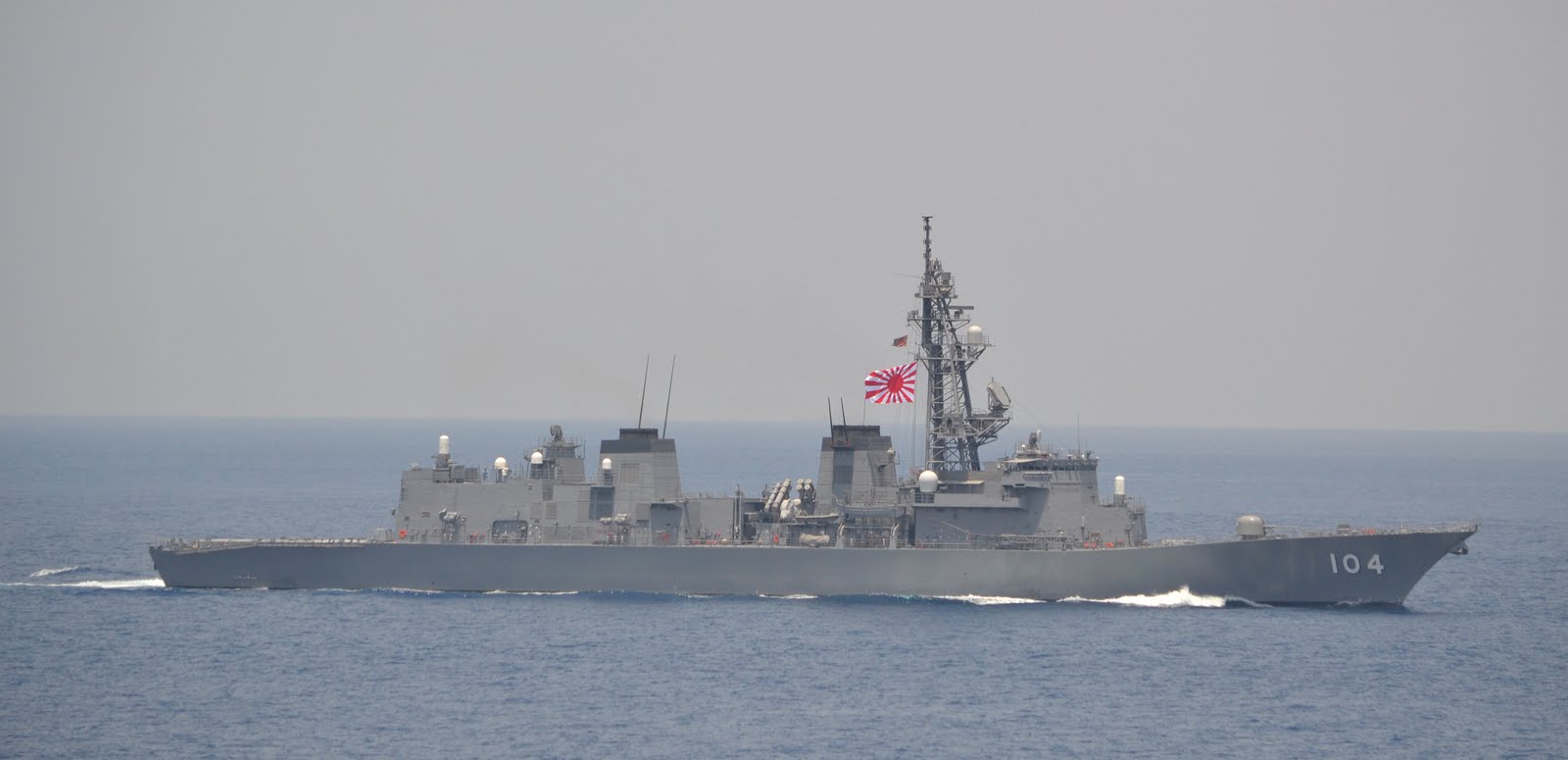

We made it safely past the pirate area in the Gulf of Aden. Our crew took many precautions to protect us from Somali pirates, who take many ships hostage in this area, demanding ransom.
During the two days that it took to pass through this area, we traveled in a convoy with several other ships, and we were accompanied by a Japanese Coast Guard ship on the rear and another coast guard ship in front. The crew covered all of our windows with cardboard to make it more difficult to see our ship, and we were not allowed to go out on the decks after dark.
If pirates tried to enter our ship, they would approach in small speed boats that are not visible on radar, and they would shoot ropes up to our decks, which they would then climb. Our lowest open deck is on the seventh floor, and is usually used as a bar for crew members. While we passed through the Gulf of Aden, the crew closed off this deck and also put razor wire around it, as you can see in the photo. (The other photo shows the Japanese Coast Guard ship that accompanied us). A bar for passengers is one deck higher, and every night crew members kept watch on this deck.
We are safely through the area, and had no pirate incidents, although pirates were on everybody's mind. In the daily ship newspaper there was an announcement for a "yoga and pirates" class, the typical Japanese mistake of mixing R and L.
While most of the world sees the Somali men who target ships in this area as pirates, the pirates see themselves as a volunteer coast guard. Since Somalia has no Coast Guard, many foreign fishing vessels illegally take fish in Somalia's waters, and foreign ships have also been known to dump hazardous and even nuclear waste in Somali waters, causing environmental and health problems on shore. Somali fishermen who could no longer make a living due to this illegal fishing and dumping have turned to piracy. Their efforts have greatly reduced the illegal fishing and dumping, and have also lined their pockets.
But please don't worry - we are in safe waters now. I will blog about our visit to Saudi Arabia soon, and you can look for my article on Peace Boat's website in a few days. Our next stop will be Kochi, India!
Sunday, March 27, 2011
Egypt


I heard that Peace Boat was the first cruise ship to visit Egypt since Egypt's revolution began, less than one month earlier. We were not allowed to enter Egypt freely, but instead were required to join tour groups. All of our buses headed to Cairo in a convoy. I don't think this requirement was anything new, but the many military tanks we saw along the highway are probably new since the revolution, as the country is now under military control.
The great thing about being among the first travelers back is that there were few tourists at the pyramids, and we had them much more to ourselves than could ever normally happen. The down side was that the souvenir hawkers and camel ride vendors seemed to have saved up a month's worth of energy to expend all on us.
A few days ago in Athens I was amazed by the ancientness of the Acropolis and Parthenon. Built more than 400 years BC, they were the oldest human sites I had ever seen. But they are new compared to the pyramids at Giza, completed around 2,600 BC.
We visited Tahrir Square where much of Egypt's revolution took place, and then we met with two of the young people who were part of the revolution. They told us about some of the reasons for the revolution. These included:
- having the same ruler for 30 years
- poverty (60% of the population lives under the poverty line)
- poor health care (because of a lack of hospital beds, many patients sleep on the floor)
- police violence
- human rights violations such as lack of free speech, and an "emergency law" which allows people to be jailed for opposing the government, for example in a blog or newspaper
The young revolutionaries felt very good about conducting their revolution in a peaceful way. Because the media was controlled by the government, they did much of their organizing over Facebook and Twitter, and this was successful even though only six percent of Egyptians have access to the internet.
Since President Mubarak stepped down, Egypt has been under military control, and the military will run the country until elections are held in September.
When asked about the situation in neighboring Libya, the revolutionaries expressed their disappointment that Qaddafi has not stepped down, but they spoke against foreign military intervention. "We do not need another war in the world," one of the revolutionaries said. "Who knows if those countries will pull out after overthrowing Qaddafi? A revolution can be done peacefully."
Monday, March 21, 2011
Naples, Italy: Atomic Bomb Survivors Call for Abolition of Nuclear Power

Nine survivors of the atomic bombings of Hiroshima and Nagasaki were on a bus in Naples, Italy, when they heard the news that hundreds of people are being treated for radiation exposure due to explosions at a nuclear power plant in Fukushima, Japan in the aftermath of the massive earthquake that struck Japan on March 11. The atomic bomb survivors, or Hibakusha in Japanese, gave testimony of their experiences several times in Naples, to junior high school students and to the public.
"The most horrible part of the atomic bomb is the radiation that it releases," said Sakaguchi Hiroko, a second generation Hibakusha whose mother was exposed to the atomic bomb at the age of 23 in Nagasaki. "Radiation has no color or shape. However, it penetrates the body and damages DNA." Because Ms. Sakaguchi's mother was not near the hypocenter of the atomic bomb, she didn't have any immediate injuries. But later she died of rectal and lung cancer.
The radiation released from an atomic bomb and the radiation released when a nuclear power plant malfunctions are the same, and Ms. Sakaguchi is concerned for the people who have been or are being exposed to radiation in Japan following the earthquake and tsunami which led to an explosion at a nuclear power plant. "The myth that Japanese technology is good enough to make nuclear energy safe and clean has been broken by this earthquake," Ms. Sakaguchi said. "We cannot stop earthquakes, but we can stop nuclear power. And we must," she said, quoting Felicity Hill, a leader in the struggle against nuclear energy. She urged the audience to work toward developing sustainable energy and creating a world with no war and no nuclear weapons. "It's not only the nuclear bomb, it's all stages of the nuclear fuel cycle, including the uranium mining, that create risks for human beings."
Ms. Sakaguchi, born four years after the atomic bomb, emphasized that radiation affects not only those who are exposed but also future generations. "Radiation causes a special damage, and that damage is also in my body," she said. Several of her classmates and cousins, also second generation Hibakusha, have died of leukemia.
An Italian junior high school student asked why Japan, after having experienced nuclear bombs, has nuclear power plants. Tasaki Noburo, who was exposed to the atomic bomb in Nagasaki, explained that until now Japan has relied heavily on nuclear power, and has exported nuclear power overseas. "But because of the earthquake we now know for sure that nuclear power plants are very dangerous," he said. He recommended the use of solar and natural energy. "The use of nuclear power is not just a problem in Japan. Many countries use nuclear power, and they all share the same concern," he said. "As Hibakusha we know the horrors of radiation. We really have to think about how to move forward to make clean and safe energy," he said.
Yamanaka Emiko, exposed to radiation in Hiroshima when she was 12 years old, explained how radiation affects not only future generations, but also human relations. "When I was a teenager I had a boyfriend," she said. "For four years we had a lovely relationship, and eventually he proposed to me. But his parents forbade our marriage, saying that they didn't want any Hibakusha in the family."
Nishida Goro, exposed to the atomic bomb in Hiroshima at the age of three, also emphasized that radiation is the scariest part of nuclear weapons. Mr. Nishida's mother was not in Hiroshima when the bomb exploded, but she was unknowingly exposed to radiation when she entered the city of Hiroshima several days later. His mother passed away when he was in high school, after she had suffered many years from an enlarged spleen caused by radiation. "Radiation is invisible but it comes out in sicknesses such as cancer and leukemia, and it has a strong effect on people and the environment," Mr. Nishida said.
Currently in Japan, radiation has been released during several explosions at a nuclear power plant in Fukushima, and radiation has been detected in the populous Tokyo area.
Kakefuda Itsumi, a psychologist in Tokyo, said that in evaluating nuclear power people should consider the psychological impact of nuclear disasters. "People in Tokyo and the surrounding area are experiencing a lot of stress due to worry about radiation," she said. "Some have started to move away. Radiation is not visible, and people can't obtain accurate information. Even the authorities don't know what is happening," she said. "Nuclear power plants are not worth having."
Wednesday, March 16, 2011
Worried about Japan

I was on a bus with nine Hibakusha (survivors of the atomic bombings of Hiroshima and Nagasaki) when I heard the news that 400 people in Japan are now receiving treatment for radiation exposure due to the nuclear accident caused by the earthquake in Japan. The Hibakusha had just given testimony about their experience of nuclear bombs to a group of junior high school students in Naples, Italy. I'll have an article about it on the Peace Boat website soon.
It seems like my friends in Japan are doing ok, although I'm very worried about the radiation. I am not able to get news every day, but today in Naples I was able to use internet, and buy an English newspaper. On the ship we're doing fine although of course people are worried.
Here is a photo of me in Morocco taken just before the earthquake. This party was our welcome as we got off the ship! My favorite experience in Morocco was going to a hammam (public bath) with two friends. We were scrubbed, massaged, covered in mud and wrapped in plastic, and it was sooooooo relaxing. Also in Morocco, I visited an NGO that works with street kids.
Before Morocco, we stopped in Las Palmas on Spain's Canary Islands, and I visited a center for immigrants. I've also been busy onboard giving a couple of presentations about migrant farm workers and immigration issues and human trafficking.
Tonight we will leave Naples, and in a couple of days we'll be in Piraeus, Greece.
Friday, March 4, 2011
In a new ocean


We spent an entire day passing through the Panama Canal, and then we were in the Atlantic! I had a free morning in Panama so I went to the beach with a couple of the English teachers onboard. In Cartagena, Colombia I visited a dance school that teaches low-income kids to become world class dancers, and in Trinidad (Trinidad and Tobago) I went to a steel pan factory and learned how that instrument is manufactured. I haven't had time for blogging, but you can read my articles about the ports and more on Peace Boat's website. Now we are crossing the Atlantic, heading for the Canary Islands. In a few days we'll be at the mid-way point around the world.
Due to the war going on in Libya, we won't be stopping there, and we will instead spend an extra day in Naples. It looks like things have settled down in Egypt and we will be able to go there, and if everything works out with visas and government permission we will also make a quick stop in Saudi Arabia!
Onboard, I'm busy with events and writing articles. I gave a talk on migrant farm workers a few days ago. Also, I have a volunteer Japanese teacher (classes started last week), and amazingly I have a lot more opportunity to practice Japanese here on the ship than I ever did in Japan. I try to go to dinner by myself rather than with other volunteers. That way I get seated with passengers, and they are always happy to try to chat with me in Japanese. I've been improving at making basic conversation. Many of the passengers are retired people, and since older Japanese people tend to speak less English, and they have lots of time, they make good conversation partners for me.
Here's a picture of a performance at the dance school in Cartagena, and one of me climbing up on the top deck of the ship trying to get a good shot of the Panama Canal locks.
Monday, February 21, 2011
Just left Peru!

We made it across the Pacific and spent two days in Peru where I joined a cultural exchange with a theatre and art collective in a slum near Lima. They have a circus which provides education and fun for local kids. You will be able to read more about it on the Peace Boat website in a few days.
Tomorrow we will pass through the Panama Canal and stop in Cristobal, Panama, on the Atlantic side of the canal. I've been pretty busy writing for Peace Boat, and haven't had much time to write on my own blog, but I'm enjoying this voyage immensely, meeting many great and fun people and learning and participating in all kinds of interesting things. I do miss being in touch with all my friends and family, though! I hope you're all well.
Friday, February 11, 2011
Aboriginal Australians and uranium mining

On Peace Boat I interviewed a group of Aboriginal and activist Australians regarding uranium mining. Getting to know many interesting guest educators who are onboard between ports is one of the many things I'm enjoying on the ship, and I particularly enjoyed writing about this group. If you have a chance to read just one of my articles, I recommend this one:
Thursday, February 10, 2011
Aboriginal Australians and uranium mining

On Peace Boat I interviewed a group of Aboriginal and activist Australians regarding uranium mining. Getting to know many interesting guest educators who are onboard between ports is one of the many things I'm enjoying on the ship, and I particularly enjoyed writing about this group. If you have a chance to read just one of my articles, I recommend this one:
Sunday, February 6, 2011
Swimming with sharks, petting sting rays


Yesterday I swam with sting rays and black tip reef sharks on the island of Moorea, next to Tahiti! The sting rays rubbed up against me and let me pet them. They feel exactly like cooked portabello mushrooms! The sharks were small, and although they were literally right next to us, and I could look right at them with a snorkel on (my first snorkeling experience - thanks to Lasik!) our guide said that they have plenty to eat and are not interested in biting humans.
I also got to snorkel over a coral reef, and I saw lots of tropical fish, sea anemones with fish swimming among them just like Nemo, and lots of sea creatures that I can't identify. Since it's my job to report on the voyage, I get to go on tours for free at most of the ports. And I'm lucky it's free, because Tahiti is VERY expensive! A can of beer at a convenience store costs US $4, and my dinner of raw tuna in coconut milk, and no beverage, cost $17!
Today we are back on the boat heading toward South America, and our next stop will be Callao, Peru on February 17. Onboard there is lots to do and I seldom have any down time. During the first segment of the voyage, we had a conference onboard which brought together survivors of the atomic bombs in Hiroshima and Nagasaki, Tahitians fighting to get compensation from France for the health effects caused by French nuclear testing in French Polynesia, and Aboriginal Australians fighting the uranium mining that is destroying their home and their health. As a reporter, I have a chance to interview all of the interesting guest speakers who come onboard. I especially enjoyed getting to know the Australians and writing about their issue, which is devastating their communities. My article about them will be posted on Peace Boat's website in a couple of days. http://www.peaceboat.org.
In researching the article about the Tahitian nuclear test site workers, I learned that France conducted 46 atmospheric and 137 underground nuclear tests in French Polynesia between 1966 and 1996. Before 1966, France tested nuclear weapons in the Sahara Desert in Algeria. The local workers, working next to the mushroom cloud, had nothing but army-issued shorts and T-shirts to protect them. The U.K. and the U.S. conducted even more nuclear weapons tests. The U.K. tested nuclear weapons on Aboriginal land in Australia, and on Christmas Island, and the U.S. did nuclear testing in the Marshall Islands, which the ship passed a few days ago, as well as New Mexico and Nevada.
Local people are still suffering and dying because of this, and the environment is forever destroyed. What makes some countries feel that they can test nuclear weapons in places inhabited by people they deem less important? Many of the tests were done not to gain scientific information, but merely to show off might. It's nuclear colonialism and nuclear racism, and it continues to be perpetrated to this day. Countries that buy uranium from Australia are causing Aboriginal people who live near the mines to become sick and die. We need to stop using nuclear power as well as eliminate nuclear weapons!
But not everything is serious on the ship -- the weather has been beautiful and tropical for the last couple of weeks, and I usually eat breakfast and lunch outdoors on the pool deck. I have a nice spot for practicing yoga in front of windows looking out at the sea, but I haven't yet been able to do balance poses on the moving ship! Dancing is more difficult, but fun, on a ship too. When I'm in my room, which is on the 4th deck, just above the water line, I can hear the waves crashing against the outside of the ship.
We crossed the International Date Line last week, and so January 30 was 48 hours long for us. I haven't seen my email in almost two weeks, but I'll try to check in and answer them soon! I hope that you are healthy and happy and staying warm!
The photos above show me swimming with a sting ray, sting rays and sharks swimming where I swam, and me at the beach in Moorea. The water was an amazing turquoise!
Wednesday, January 26, 2011
Day Five at Sea


When I was in high school I had a fantasy that I would get a job on a ship and travel around the world. In my fantasy, I worked my way around the world by carrying crates on and off the ship. I never imagined that in reality I would work for my passage by taking photos and writing to promote peace.
From Japan we headed south to a warmer climate where we can enjoy the pools and jacuzzis on deck. Now we are heading southeast toward Tahiti. I've been busy taking photos and writing about the guest educators that are on the ship with us for this portion of the voyage. Over the next week we will have an onboard global conference to promote a nuclear-free world. The conference will include Japanese survivors of the atomic bombing of Nagasaki and Hiroshima, Tahitians opposed to France's testing of nuclear weapons in Tahiti, and aboriginal Australians who oppose the destructive mining of uranium which causes their traditional lands to be contaminated with radiation. We will learn about all stages of the nuclear fuel cycle.
I'm enjoying getting to know the volunteers, staff and participants who are onboard, and we've had parties, dances, games and general fun. The volunteers come from around the world. Last night we had a Fiesta Latina, and the day before we saw a Tahitian and Hawaiian dance and music performance.
When I stand on the deck I see nothing but water in every direction. I haven't even seen any other ships. The horizon is all around me. I can hear the sloshing of the waves against the ship.
I haven't had any motion sickness so far, but I'm drinking ginger tea, a natural remedy, just in case. I share a cabin with a roommate. She grew up in Japan and New Mexico! Our cabin is a bit smaller than a college dorm, but we each have a bed, closet, safety box, drawer, and there is a bathroom and shower for us. We are on the fourth deck, out of 11 decks. We do have two windows in our room, but we can't open them on the open sea. We may be able to open them when we are on the Mediterranean Sea since it will be calm.
For breakfast and lunch, we have buffet-style meals, and every day we have a nice dinner that is served as in a nice restaurant. Sometimes the restaurant serves Japanese food, and sometimes it serves western food. We have two swimming pools, three jacuzzis and a gym, which I have been using every morning. We also have several auditoriums for lectures and parties, and every day is very busy!
One fact of traveling around the world eastbound is that nearly every night we must set our clocks one hour ahead. I had better start getting used to 23-hour days!
I've been writing about and photographing the many events on board, and my first report was posted on the Peace Boat website yesterday. You can follow my reports at http://www.peaceboat.org. Click on the link for the 72nd (current) Voyage. I'm writing this blog entry offline, and when I go online to upload, it will be my first time trying to use satellite internet from the ship. Satellite internet is slow and expensive, so please understand why I haven't answered any emails.
Thursday, January 20, 2011
Departing for a voyage around the world!

In two days I'll be leaving for an 86-day voyage around the world working as a volunteer web reporter on Peace Boat, a Japan-based NGO that works to promote peace, human rights, equal and sustainable development and respect for the environment. I'll be writing articles and taking photos for Peace Boat's website, and you will be able to read them here:
They will be posted toward the bottom of the page.
In addition, I will update Peace Boat's Facebook page every few days, so if you would like to see where I am and what I am doing, "like" Peace Boat on Facebook. Let me know if you don't find it and would like me to send you an invitation.
Aside from my duties as a web reporter, I will have limited internet access during the voyage. I will post a blog entry from time to time at http://travelingkimi.blogspot.com/, which will be automatically posted on Facebook, but aside from that my use of Facebook will be very limited, so please contact me by email, and don't be surprised if it takes me awhile to answer. I'll try to check in about once a week. Nonetheless, I look forward to hearing from you! I will return to Japan on April 18.
Thursday, December 30, 2010
Happy New Year!


the best in 2011!
Wednesday, November 17, 2010
"Just lynching"
I read an article about Japanese girl gangs that engaged in lynching. The article, about the world’s five most bizarre gangs, said that sukeban, or Japanese girl gangsters, modified their school uniforms, used yo-yos as weapons, and sometimes engaged in lynching.

I asked Itsumi about sukeban. She said that when she was in high school in the 80s the sukeban were the girls who drank and smoke and maybe shoplifted, but they weren’t really so bad. They were well-liked, and sometimes stood up for other kids against the school authorities.
I asked Itsumi if the sukeban ever did anything violent, and she said not really, by today’s standards. But sometimes there was conflict between different groups of sukeban or within the group, and they burned each other with cigarettes. I asked if there was anything else, and she said not really, just lynching.
“JUST lynching?” I said. Occasionally, she said, but it wasn’t too serious.
Japanese borrows many words from English, and sometimes uses them in novel ways. For example, in Japanese, a “mansion” is an apartment building with more than four floors. And “lynching,” it turns out, means several people beating one person up, and it’s usually not a very serious beating.
In English, unfortunately, lynching means “to put to death, especially by hanging, by mob action and without legal authority.”

I asked Itsumi about sukeban. She said that when she was in high school in the 80s the sukeban were the girls who drank and smoke and maybe shoplifted, but they weren’t really so bad. They were well-liked, and sometimes stood up for other kids against the school authorities.
I asked Itsumi if the sukeban ever did anything violent, and she said not really, by today’s standards. But sometimes there was conflict between different groups of sukeban or within the group, and they burned each other with cigarettes. I asked if there was anything else, and she said not really, just lynching.
“JUST lynching?” I said. Occasionally, she said, but it wasn’t too serious.
Japanese borrows many words from English, and sometimes uses them in novel ways. For example, in Japanese, a “mansion” is an apartment building with more than four floors. And “lynching,” it turns out, means several people beating one person up, and it’s usually not a very serious beating.
In English, unfortunately, lynching means “to put to death, especially by hanging, by mob action and without legal authority.”
Monday, November 8, 2010
Machine demolishes landmines, as more are installed
 Hitachi Construction Machinery Company has built a machine that can hammer its way across the countryside, smashing landmines to pieces.
The machine is so sturdy that exploding landmines seldom damage it. Larger mines, the type designed to destroy tanks, cause minor but reparable damage to Hitachi’s machine. 
I recently had a chance to see and climb into this machine at a Universal Design exposition that Itsumi attended for her work. I saw a display of some common landmines, including mines produced by the U.S. (below photo, third from left). This photo shows landmines produced by the U.S., Russia, Iran and China. The large ones on the right are designed to destroy tanks.
This photo shows landmines produced by the U.S., Russia, Iran and China. The large ones on the right are designed to destroy tanks.There are more than 200 types of landmines. While some are designed to injure or kill adult civilians, others are specifically designed to target children. Today, there are hundreds of millions of land mines waiting to explode in some 120 countries. In Cambodia and Angola, for example, there are two landmines for every child, and forty percent of the victims of landmine explosions are children.
 Detonating mines by hand is very slow and very dangerous, causing many deaths every year. Hitachi’s machine uses flailing hammers to detonate mines while the operator is safely inside a sturdy cab. On the back of the machine, a tiller prepares the de-mined area for farming.
So far, seventy of Hitachi’s machines have been delivered to Angola, Cambodia, Thailand, Vietnam, Colombia and Nicaragua. The focus has been on demining fields that surround schools and housing areas.
It takes only about $5 to install a landmine, but removing it is incredibly expensive. I can’t imagine how difficult it must be just to transport and maintain demining machines in countries that have few roads. When I visited Laos, I learned that per capita Laos is the most heavily bombed country in the world. More than 1.3 million tons of ordnance were dropped on Laos between 1964 and 1973, mostly cluster bombs of which 30% did not detonate. Ten of the 18 Lao provinces are severely contaminated with land mines and many other types of UXOs.
The U.S., responsible for this contamination, has still not signed the Ottawa Treaty against landmines. Parties to the Ottawa Treaty agree to destroy landmines within their possession, clear their territory of mined areas, provide assistance to mine-affected persons in their own country and provide assistance to other countries in meeting these treaty obligations.
The U.S. should sign the Ottawa Treat, and take action to stop the production of landmines.
Tuesday, October 12, 2010
I can see clearly now...
The morning before my intra lasik surgery, I read and signed the doctor's informed consent form, which made it explicitly clear that by undergoing this elective surgery I could become permanantly unable to drive, or even go blind. Contemplating this, I took what potentially could have been my last look at some photos of my family before taking the 40-minute train ride to the clinic.
The surgery was quick. Throughout the process I was supposed to look up at a light. I continued to do so but for a few minutes when my corneal flap was open I was not able to see much but gray, even though my eyes were open. The other disconcerting thing during surgery was that I could smell my eyeballs vaporizing, which smelled like burning flesh, and I have to admit that, thinking about that informed consent form, I was pretty terrified. But the doctor continually talked to me in English during the surgery, encouraging me, and I was glad that I could only hear his words and couldn't understand what was said among the technicians and assistants in the room. I didn't really feel pain during surgery, since my eyes were numbed by drops.
The hours immediately after surgery were uncomfortable, so I went to bed as soon as possible, wearing goggles to prevent me from rubbing my eyes.
The next morning, I could see at a distance but everything, near and far, was blurry. This worried me, but when I went back for my next day checkup Dr. Aoyama assured me that the blurriness is caused by dryness, because the layer of tears is gone from my eyes, and that it is normal and temporary.
Something that surprised me was that, after surgery, ordinary things like beverage cans and letter-sized paper and magazines seem much bigger than before, so much so that I have to read the labels in order to know what size things are. This is because I am suddenly free from glasses, and glasses cause things to appear smaller.
I need to take good care of my eyes in the coming months so that they heal properly, but I am looking forward to
1. buying my first pair of fashionable sunglasses
2. going scuba diving for the first time, and
3. seeing the inside of showers.
This morning, two days after surgery, I have already done two of those things, and I woke up singing "I can see clearly now ..." Everything looks clear and wonderful!
The surgery was quick. Throughout the process I was supposed to look up at a light. I continued to do so but for a few minutes when my corneal flap was open I was not able to see much but gray, even though my eyes were open. The other disconcerting thing during surgery was that I could smell my eyeballs vaporizing, which smelled like burning flesh, and I have to admit that, thinking about that informed consent form, I was pretty terrified. But the doctor continually talked to me in English during the surgery, encouraging me, and I was glad that I could only hear his words and couldn't understand what was said among the technicians and assistants in the room. I didn't really feel pain during surgery, since my eyes were numbed by drops.
The hours immediately after surgery were uncomfortable, so I went to bed as soon as possible, wearing goggles to prevent me from rubbing my eyes.
The next morning, I could see at a distance but everything, near and far, was blurry. This worried me, but when I went back for my next day checkup Dr. Aoyama assured me that the blurriness is caused by dryness, because the layer of tears is gone from my eyes, and that it is normal and temporary.
Something that surprised me was that, after surgery, ordinary things like beverage cans and letter-sized paper and magazines seem much bigger than before, so much so that I have to read the labels in order to know what size things are. This is because I am suddenly free from glasses, and glasses cause things to appear smaller.
I need to take good care of my eyes in the coming months so that they heal properly, but I am looking forward to
1. buying my first pair of fashionable sunglasses
2. going scuba diving for the first time, and
3. seeing the inside of showers.
This morning, two days after surgery, I have already done two of those things, and I woke up singing "I can see clearly now ..." Everything looks clear and wonderful!
Wednesday, September 8, 2010
Orlando
I just learned that my good friend Orlando Martinez passed away.
Orlando, then around 70, kept me company through law school, informing me at great length about communism, capitalism and all sorts of topics, and reminding me of things other than the narrow world of law school. Orlando often brought me a bowl of homemade chicken soup and a welcome break from my studies.
At that time Orlando was my neighbor, an artist and writer, writing for leftist publications like the Montelibre Monthly and trying valiantly to get his books published. He sometimes took care of my kitty Elfi when I was out of town, and he even painted a portrait of her as a gift for me. I treasure it. Orlando gave our apartment building a sense of community.
Once, Orlando agreed to visit my law school class as a volunteer juror for jury selection practice. He dominated the event and gave the law students some real world jury selection practice of a kind they couldn’t get from the standard law student volunteers. I don’t think anyone else got a word in, and I think Orlando enjoyed the disruption he created! I enjoyed it too, as I think law school students should be disrupted and made to think outside the textbooks a little more often.
One winter Orlando rescued a kitten and its mother who were in danger of freezing on the back porch of our apartment building. Together Orlando and I caught the mother kitty, which wasn’t easy because she was wild, and the pair lived in Orlando’s closet until the kitten, who Orlando named Bucky Linn, was old enough to adopt out. We found a home for her with a law student.
Orlando moved to Albuquerque, but we kept in touch and I visited him one year at Christmas time. We had Christmas dinner at a youth hostel in Albuquerque, and I enjoyed watching Orlando entertain the other guests.
In his later years Orlando became an advocate for the rights of medical patients, and he was a generous donor to the scholarship fund for Lidia, a young woman who I met in Bolivia. Thanks to the donations of Orlando and many of my friends and family, Lidia has completed more than half of her five-year nursing course.
Orlando was a regular reader of my blog, and he often chided me when its contents were not political enough.
Orlando delighted in making people think, and in helping others. I will miss him dearly.
Orlando, then around 70, kept me company through law school, informing me at great length about communism, capitalism and all sorts of topics, and reminding me of things other than the narrow world of law school. Orlando often brought me a bowl of homemade chicken soup and a welcome break from my studies.
At that time Orlando was my neighbor, an artist and writer, writing for leftist publications like the Montelibre Monthly and trying valiantly to get his books published. He sometimes took care of my kitty Elfi when I was out of town, and he even painted a portrait of her as a gift for me. I treasure it. Orlando gave our apartment building a sense of community.
Once, Orlando agreed to visit my law school class as a volunteer juror for jury selection practice. He dominated the event and gave the law students some real world jury selection practice of a kind they couldn’t get from the standard law student volunteers. I don’t think anyone else got a word in, and I think Orlando enjoyed the disruption he created! I enjoyed it too, as I think law school students should be disrupted and made to think outside the textbooks a little more often.
One winter Orlando rescued a kitten and its mother who were in danger of freezing on the back porch of our apartment building. Together Orlando and I caught the mother kitty, which wasn’t easy because she was wild, and the pair lived in Orlando’s closet until the kitten, who Orlando named Bucky Linn, was old enough to adopt out. We found a home for her with a law student.
Orlando moved to Albuquerque, but we kept in touch and I visited him one year at Christmas time. We had Christmas dinner at a youth hostel in Albuquerque, and I enjoyed watching Orlando entertain the other guests.
In his later years Orlando became an advocate for the rights of medical patients, and he was a generous donor to the scholarship fund for Lidia, a young woman who I met in Bolivia. Thanks to the donations of Orlando and many of my friends and family, Lidia has completed more than half of her five-year nursing course.
Orlando was a regular reader of my blog, and he often chided me when its contents were not political enough.
Orlando delighted in making people think, and in helping others. I will miss him dearly.
Friday, July 23, 2010
Lying fallow in Anhui
The morning after hiking Huang Shan my legs and knees ached so much that I could barely descend from my third-floor hostel room, so I decided to take a quiet trip to a village. The villages around Tunxi are known as Huizhou style. Absent any kind of economy beyond subsistence farming, the locals traditionally sent their sons away at the age of 13 to work as merchants. Many did well, and sent money back to their villages, where their families built mansions. Today the village lanes ramble among crumbling Ming and Qing era black and white tile-roofed structures, while farmers continue to harvest rice in the same way they have done for centuries.
I chose to visit Chengkan, dating from the Han Dynasty, because farmers rather than tourists continue to walk along its narrow winding alleys. The fact that it takes a series of four buses to get from Tunxi to Chenkan may be what keeps the tourists away. On the fourth bus, a man deposited a huge bag of Purina feed, paying the driver to deliver it somewhere, and another man boarded with some kind of motor that he and his friend were barely able to heave up the bus steps.
The sign at the entrance of Chengkan said “Welcome to Chengkan for tourism, visit, research, making holiday, lie fallow and sketching.” My aching legs told me that my plan in Chengkan was to lie fallow as much as possible.
I chose to visit Chengkan, dating from the Han Dynasty, because farmers rather than tourists continue to walk along its narrow winding alleys. The fact that it takes a series of four buses to get from Tunxi to Chenkan may be what keeps the tourists away. On the fourth bus, a man deposited a huge bag of Purina feed, paying the driver to deliver it somewhere, and another man boarded with some kind of motor that he and his friend were barely able to heave up the bus steps.
The sign at the entrance of Chengkan said “Welcome to Chengkan for tourism, visit, research, making holiday, lie fallow and sketching.” My aching legs told me that my plan in Chengkan was to lie fallow as much as possible.

Outside the city gates I paused to watch the rice farmers tending their paddies. In several inches of water one man in waders uprooted the densely planted seedlings and stacked them in a basket. Another man, barefoot, re-planted the seedlings, one by one, in the next water-filled paddy while a third man, also barefoot, used a hoe to shore up the clay wall of the paddy. In another paddy, an ox chewed its cud while waiting, hitched to a wooden plow.
In the distance, other farmers performed the same tasks, and one man stood on his wooden plow while a water buffalo pulled it around and around in the paddy.
The farmer who had been pulling the seedlings finished this task and stopped to take a drink. I greeted him with ni hao and offered him a package of Oreos. He refused it but said something to me in Chinese which sounded friendly enough.
The man who had been hoeing put a board over his shoulder and, balancing two huge baskets of wet seedlings, staggered to carry them to the next paddy.
All of the tools, including the plow, hoe, ox yoke, baskets and trays to hold the baskets appeared to be hand made, of wood and reed.

I paid 80 RMB (US $11) to enter the city gate of Chengkan. Villages in China charge a steep entrance fee, double the price of a night in a hostel.  Chengkan is a quiet village consisting of a maze of narrow winding lanes between high walls concealing I don’t know what. I spent a morning wandering among the picturesque lanes and avoiding dogs as best I could, since China has a big rabies problem, and a traveler from Ireland told me that he had nearly been bitten in a village.
 When I saw a woman washing her clothes in the river, beating them with a stick, I felt silly for having been disappointed that the spin cycle on my hostel’s washing machine hadn’t worked the day before, and I had had to wring my clothes dry by hand before hanging them to dry on the bamboo pole.
I had lunch at the village’s only restaurant. The waitress spoke a little English, and asked me if I wanted rice, noodles or dumplings. After I chose rice, she asked me to step into the kitchen and choose a vegetable. Since vegetables are not cooked together, I could only choose one. So I got a huge bowl of plain rice and a plate of cabbage fried with garlic and bother. Together with a beer for the hot day, it was a pretty good lunch. On the way back to Tunxi, two of the four bus drivers remembered me and gleefully helped me get on the right series of buses.
The next day I took a bus to Hongcun, a more touristed but still beautiful village, famous for its Moon Pond.  In Hongcun, I rented a bicycle to ride out of town to the Mukeng Bamboo Forest, where parts of Crouching Tiger Hidden Dragon were filmed.

I rented the bike solely using gestures and drawings, and amazingly the shopkeeper and I correctly communicated the price, rental period and deposit which would be returned to me.
Anhui is a peaceful respite in bustling China.
Saturday, July 17, 2010
Anhui: The New Mexico of China
I took the maglev train travelling 301 km/hr (187 mph) from the airport to downtown Shanghai. Maglev is short for magnetic levitation, because the train doesn’t actually touch the tracks. Magnets provide lift and propulsion, so the train hovers just above the tracks, eliminating all but air friction and electro-magnetic drag. Maglev trains are quieter, faster and smoother than wheeled mass transit systems. China’s is the world’s most well-known commercial high-speed maglev. Its top speed is 381 km/hr (268 mph). By bus the trip would take 45 minutes, but we made it in 7 minutes 20 seconds, just slightly slower than an airplane could, and I found myself wondering why we don’t have a better public transportation system in the U.S.
At a youth hostel on East Nanjing Road I dined on take-out pizza and beer. For some reason the multitude of Pizza Huts in Shanghai had caught my eye, and I didn’t yet know that a meal of pizza cost about six times the price of a much tastier Chinese meal.
In the hostel I met backpackers from South Korea, Canada, China and the U.S. A man from Tennessee who had lived in Japan gave me his three-day pass to the Shanghai World Expo, with two days unused. He said that it was disappointing, and one day was enough for him.
In the morning I had spicy sour ramen noodles (8 RMB) while reading the China Daily. Drawn by the sound of drumming, I headed to a little park sandwiched between high rises and glittering shopping malls. A group of women was busily drumming and marching in formations. Further down, the tree-lined pedestrian lane was crowded with small groups of senior citizens doing tai chi and other exercises. One group of particularly energetic middle aged women was performing an aerobic dance to Chinese pop music using pink rubber balls as props.
I had read that because only two percent of Chinese smile at strangers, the government hired professional smilers to encourage smiling among the population before the Expo, so that visitors would feel more welcomed. Either it worked, or the original statistic was wrong, because in the bustling city of Shanghai, strangers greeted me with “ni hao,” smiled at me, waved, and generally tried to communicate with me in a friendly way. Shanghai felt vibrant and warm, brimming with talking and laughing and cheerful activity.
I spent a day at the expo which involved lots of waiting in lines to finally walk through mediocre exhibits consisting mostly of videos and a few products from each country while throngs of Chinese people rushed to get their Expo passports stamped but didn’t seem to look much at the exhibits. I realized that I’m pretty fortunate to be able to collect stamps in my real passport. Below is Britain's Seed Pavilion.

The two highlights of the day were the stuffed grape leaves I ate at a Bulgarian restaurant, and the African Pavilion in which countries which could not afford their own pavilion created smaller exhibits in a shared building. Their lower tech exhibits were actually more interesting, and had fewer lines. But overall I tend to agree with the man from Tennessee who gave me the three-day pass. The Expo is a huge waste of money and resources, and since all the buildings but two are built with temporary building materials and will be torn down in six months, it is an environmental outrage.
When Expos began in the mid 1800s, they were a place to showcase new technology and inventions like the ice cream cone which made its debut at an expo in the early 1900s. But today the expo seems to be a reluctant exercise in foreign relations. The U.S. nearly didn’t participate this year due to a lack of funds, but not participating would have been such an affront to foreign relations with China that the U.S. eventually raised the funds and built a large pavilion.
After a night in the hostel dorm room with four Chinese women who came to Shanghai to see the expo, I got up early to take a morning bus to Tunxi, a small town in the beautiful but impoverished Anhui province.
So far I had not seen the famed Chinese ni hao toilets “hello toilets” where everyone reportedly squats together with no privacy walls. The expo and other places I had been in Shanghai had great toilets, often even with paper. I hoped to see a ni hao toilet at the long distance bus station, but instead I found individual stalls with a shared trough running through. No need to flush, as water automatically flushes through the trough regularly. It’s a pretty good system, but the only strange part is that one can see other people’s business floating by in the trough.
Before the bus took off, the driver handed each passenger a plastic bag. “Bag” he said to me in English, passing me mine. I wondered if it was for vomiting in, as I had done years ago on a mountainous bus ride in Mexico. But I decided hopefully that it must be for garbage. Later I saw a man spitting in his, employing that less than endearing Chinese practice of loudly hacking and spitting, usually done on the street. Apparently people are not able to refrain from doing it during a bus ride.
Chinese people seem to readily talk to strangers on buses and in public places. The man sitting next to me on the bus to Tunxi tried valiantly to have a conversation with me. Unable to understand anything he said, I handed him my phrasebook which gave him and his friends some good chuckles but didn’t help us communicate much.
To me, Anhui is the New Mexico of China. Frequent floods and mountains keep its agricultural ability marginal, and it has no other industry, but the atmosphere is laid back and the mountains and ancient villages are absolutely stunning. Anhui’s top draw is Huang Shan, a mountain comprised of a collection of granite cliffs laced with trails on the side of sheer cliffs flanked by odd and beautifully shaped trees and shrouded in misty clouds. Huang Shan’s beauty inspired a whole school of ink painting during past centuries, which even extended to Japan, and more recently it inspired the set of the movie Avatar.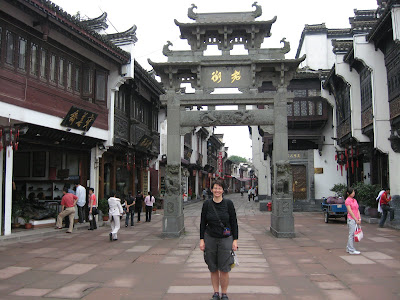

I spent a day in Tunxi, absorbing the beauty of the Ming Dynasty (1600s-1800s) architecture that surrounded Ancient Town Youth Hostel, getting a foot reflexology treatment and stocking up on supplies for the two-day trek on Huang Shan. Seeking trail food among the aisles of unfamiliar food at Tunxi’s supermarket left me with a couple of duds (black hard boiled eggs – eeew – and dried fruit meant for cooking, not eating raw) but mostly hits (jerkey of unknown meat, canned tuna, cookies, chocolate) and I found an especially good bonanza at a local bakery (cheese and herb bread - yum!).

On the bus to Huang Shan a collection of solo backpackers from Holland, England, China and Ireland befriended me. Together we took the cable car part way and then hiked up the east slope, through packs of package tourists in matching hats swarming around megaphone-wielding guides. Still we managed to take some pictures of the beautiful Huang Shan pine trees for which Huang Shan is famous.

After 2 ½ hours we left the hordes behind and entered the loop, which consists of cement paths precariously built hanging from the sides of sheer cliffs. I can’t imagine how many people must have died building them. The loop hike took about six hours up and down cement steps, and is not for those afraid of heights or without sturdy knees.

We staggered to our hostel, the Baiyun, located near one of Huang Shan’s summits, where we watched the sunset from a peak and then limped to our beds in an 11-person dorm for 140 RMB per night.


At a youth hostel on East Nanjing Road I dined on take-out pizza and beer. For some reason the multitude of Pizza Huts in Shanghai had caught my eye, and I didn’t yet know that a meal of pizza cost about six times the price of a much tastier Chinese meal.
In the hostel I met backpackers from South Korea, Canada, China and the U.S. A man from Tennessee who had lived in Japan gave me his three-day pass to the Shanghai World Expo, with two days unused. He said that it was disappointing, and one day was enough for him.
In the morning I had spicy sour ramen noodles (8 RMB) while reading the China Daily. Drawn by the sound of drumming, I headed to a little park sandwiched between high rises and glittering shopping malls. A group of women was busily drumming and marching in formations. Further down, the tree-lined pedestrian lane was crowded with small groups of senior citizens doing tai chi and other exercises. One group of particularly energetic middle aged women was performing an aerobic dance to Chinese pop music using pink rubber balls as props.
I had read that because only two percent of Chinese smile at strangers, the government hired professional smilers to encourage smiling among the population before the Expo, so that visitors would feel more welcomed. Either it worked, or the original statistic was wrong, because in the bustling city of Shanghai, strangers greeted me with “ni hao,” smiled at me, waved, and generally tried to communicate with me in a friendly way. Shanghai felt vibrant and warm, brimming with talking and laughing and cheerful activity.
I spent a day at the expo which involved lots of waiting in lines to finally walk through mediocre exhibits consisting mostly of videos and a few products from each country while throngs of Chinese people rushed to get their Expo passports stamped but didn’t seem to look much at the exhibits. I realized that I’m pretty fortunate to be able to collect stamps in my real passport. Below is Britain's Seed Pavilion.
The two highlights of the day were the stuffed grape leaves I ate at a Bulgarian restaurant, and the African Pavilion in which countries which could not afford their own pavilion created smaller exhibits in a shared building. Their lower tech exhibits were actually more interesting, and had fewer lines. But overall I tend to agree with the man from Tennessee who gave me the three-day pass. The Expo is a huge waste of money and resources, and since all the buildings but two are built with temporary building materials and will be torn down in six months, it is an environmental outrage.
When Expos began in the mid 1800s, they were a place to showcase new technology and inventions like the ice cream cone which made its debut at an expo in the early 1900s. But today the expo seems to be a reluctant exercise in foreign relations. The U.S. nearly didn’t participate this year due to a lack of funds, but not participating would have been such an affront to foreign relations with China that the U.S. eventually raised the funds and built a large pavilion.
After a night in the hostel dorm room with four Chinese women who came to Shanghai to see the expo, I got up early to take a morning bus to Tunxi, a small town in the beautiful but impoverished Anhui province.
So far I had not seen the famed Chinese ni hao toilets “hello toilets” where everyone reportedly squats together with no privacy walls. The expo and other places I had been in Shanghai had great toilets, often even with paper. I hoped to see a ni hao toilet at the long distance bus station, but instead I found individual stalls with a shared trough running through. No need to flush, as water automatically flushes through the trough regularly. It’s a pretty good system, but the only strange part is that one can see other people’s business floating by in the trough.
Before the bus took off, the driver handed each passenger a plastic bag. “Bag” he said to me in English, passing me mine. I wondered if it was for vomiting in, as I had done years ago on a mountainous bus ride in Mexico. But I decided hopefully that it must be for garbage. Later I saw a man spitting in his, employing that less than endearing Chinese practice of loudly hacking and spitting, usually done on the street. Apparently people are not able to refrain from doing it during a bus ride.
Chinese people seem to readily talk to strangers on buses and in public places. The man sitting next to me on the bus to Tunxi tried valiantly to have a conversation with me. Unable to understand anything he said, I handed him my phrasebook which gave him and his friends some good chuckles but didn’t help us communicate much.
At my hostel in Tunxi I met a young Russian couple at the beginning of a two-year world traipse. They thought it was funny that I am from Minnesota, since earlier in China they had bought T-shirts that said “Minnesota” and “Iowa,” and people from those places kept approaching them.
To me, Anhui is the New Mexico of China. Frequent floods and mountains keep its agricultural ability marginal, and it has no other industry, but the atmosphere is laid back and the mountains and ancient villages are absolutely stunning. Anhui’s top draw is Huang Shan, a mountain comprised of a collection of granite cliffs laced with trails on the side of sheer cliffs flanked by odd and beautifully shaped trees and shrouded in misty clouds. Huang Shan’s beauty inspired a whole school of ink painting during past centuries, which even extended to Japan, and more recently it inspired the set of the movie Avatar.
I spent a day in Tunxi, absorbing the beauty of the Ming Dynasty (1600s-1800s) architecture that surrounded Ancient Town Youth Hostel, getting a foot reflexology treatment and stocking up on supplies for the two-day trek on Huang Shan. Seeking trail food among the aisles of unfamiliar food at Tunxi’s supermarket left me with a couple of duds (black hard boiled eggs – eeew – and dried fruit meant for cooking, not eating raw) but mostly hits (jerkey of unknown meat, canned tuna, cookies, chocolate) and I found an especially good bonanza at a local bakery (cheese and herb bread - yum!).
On the bus to Huang Shan a collection of solo backpackers from Holland, England, China and Ireland befriended me. Together we took the cable car part way and then hiked up the east slope, through packs of package tourists in matching hats swarming around megaphone-wielding guides. Still we managed to take some pictures of the beautiful Huang Shan pine trees for which Huang Shan is famous.
After 2 ½ hours we left the hordes behind and entered the loop, which consists of cement paths precariously built hanging from the sides of sheer cliffs. I can’t imagine how many people must have died building them. The loop hike took about six hours up and down cement steps, and is not for those afraid of heights or without sturdy knees.
We staggered to our hostel, the Baiyun, located near one of Huang Shan’s summits, where we watched the sunset from a peak and then limped to our beds in an 11-person dorm for 140 RMB per night.
I shared my room with nine Chinese tourists and one Columbian doctor who practices medicine in Miami but is working in Beijing for four months.
After the first day’s strenuous and knee-killing hike, Floor from Holland and I just managed to limp down to the eastern cable car. Back in Tunxi, our new Chinese backpacker friend, a pilot who had studied aviation in Phoenix, guided us to an excellent restaurant where I broadened my regular menu beyond the boiled dumplings on which I had been subsisting.
Subscribe to:
Posts (Atom)


 Posts
Posts

